Showing posts with label History Lesson. Show all posts

Thursday, January 22, 2009

Cutting Your Brewing Teeth in the Camps: Bootlegger Brown Ale

I don’t think beers need to have a gimmick to sell – good beers definitely don’t need a gimmick to sell. On the other hand, it’s always nice when a good beer has a story behind it. There’s a story behind Bootlegger Brown Ale and, while I’ve known of the story for a year or more, I’ve been unable until recently to acquire this tasty Texas brew, and that’s a story as well, I guess.

Read the story of Bootlegger Brown Ale at the Independence Brewing website and you’ll discover that the owner’s grandfather learned something of the brewing trade during a stint in the Civilian Conservation Corps (CCC). Do a Google search for the Civilian Conservation Corps and you’ll find that it was a 1930s work relief program that ultimately took some 3 million young men and put them to work in our nation’s forests, parks and fields between 1933 and 1942.


Ponder long enough on the notion of 200 young men confined in a work camp and you’ll eventually come to realize that the program wasn’t a summer day camp for sissies. Rest assured the CCC was a huge success and likely the most successful of the Depression-era New Deal programs by far, but boys will be boys and so it seems with the grand patriarch of Independence Brewing.

For those of you who may still be in the dark, Homebrewing 101 was not a course that was taught in the CCC. Odds are the predecessor to Independence Brewing’s current efforts took place in a dark corner of a barracks or mess hall, or perhaps even in an out of the way part of the park, hidden in the bushes and trees. The story of Bootlegger’s CCC past is sufficiently vague to generate curiosity and at the least a passing “that’s cool” from the average beer nut. (Of course the story of alcohol consumption in the CCC camps isn’t always a happy one. A World War I veteran in one camp died as a result of drinking vanilla extract and there are no numbers documenting how many of the thousands of vehicular accidents involving CCC enrollees also involved consumption of booze.)

I’m predisposed to like the story behind Bootlegger Brown Ale. For the record, I’m a big CCC fan. My dad was in it, but got kicked out. My mom’s dad was a U.S. Forest Service foreman and worked in CCC camps almost the entire time it was in operation. But alas, it seemed the vague CCC story connected to Bootlegger Brown Ale was going to be my only brush with the beer since it’s brewed and distributed locally and isn’t shipped out of Texas. Nevertheless, I kept a watch on the shelves of the local Total Wine and BevMo, Trader Joe’s and Sunflower Market, but no luck.
It wasn’t until I began exploring the practice of beer trading that I found someone from that part of the country who would trade me some Bootlegger for some locally brewed beers from my region. We worked the deal and SCORE! I acquired a six-pack of Bootlegger Brown Ale just after the first of the year!

Here are my notes from the initial tasting, done on the very day the package arrived, January 5, 2009:

Hint of chocolate smell and malt in the bottle. Roasted coffee in the glass. Dark brown color, not quite opaque. Nice head but quickly gone. Distinct coffee taste, medium lacing. Tastes a bit like a stout. Slightly sooty finish.

I like Bootlegger Brown Ale enough to hope that I can wrangle another trade from out of state; the likelihood of my actually getting to Texas seems remote at the moment, though there are a ton of great CCC sites scattered around the state. I might kill two birds with one stone, eh? Sample some Bootlegger Brown Ale closer to the source and visit some terrific places where the CCC did great work almost 80 years ago!


If you're lucky enough to live where you can buy it, buy it!

Tuesday, November 18, 2008

Key Indicators

I’ll confess there won’t be anything of value posted here today. Whew. That’s a load off.

What the heck is it with Germans and keys?

I’ve always been aware that the Beck’s logo sports a nice key symbol. I’ve always associated it, rightly or wrongly, with the logo used by the SS Hitler Youth during World War II. (In fact, I seem to recall that the use of the key symbol by the SSHJ was due to a connection between their outfit and Colonel Sepp Dietrich, whose last name I believe means “key” in German. And, of course if you doubt me, check it out here on a page that gives a translation for the word Dietrich. I don’t remember much, but what I do remember, I remember real good.)

So this somewhat useless bit of knowledge has been sludging round in my brainpan for years and I’ve been content to leave it alone until a couple nights ago when I sampled a bottle of Franziskaner Hefe-Weissbier. What the heck do you think was on the label but a happy little monk fellow swilling a stein of beer, with a ring of keys tied to his waist!

I did not encourage this fellow to rub his gut; he was doing that when I ran into him over at the Franziskaner website...go find it yourself.

The Franziskaner Hefe-Weissbier, eh, not so great really. Mildly sour smelling in the bottle with a strong wheat smell in the glass. Very frothy head with medium to heavy cloudiness. Just a typical wheat beer in my book and not something I’ll track down again, but I am eager to try their dunkelweizen. Maybe their dunkel is the dietrich!

Thursday, July 31, 2008

Beers of the Axis

I suppose it had to happen, what with my tendency toward history and the historic, but before I go off on this somewhat tongue in cheek tangent, I probably need to point out (to the 1 person in 100 who will somehow take this wrong and brand me a hater) the fact that this is good natured beer discussion with an admittedly awkward historical slant. I don’t mean any disrespect to the citizens of Japan, Germany or Italy, nor do I mean any disrespect to nations who might have fought with or against these nations in any wars past, present or future. Finally, having said that, I don’t think this is the last installment of this topic you’ll see here at Beer Rant. Like it or not.

Also, I’m not pretending for a second that the beers sampled for this post were beers that were produced in or by the Axis powers during World War II – I’m too lazy to verify if these beers were produced during the war.

And so, with the disclaimers out of the way, I bring you….

Beers of the Axis

Germany, Italy and Japan; the powerhouse triumvirate of the 1930s and early 1940s. Beating up on weaker or dumber neighbors, mass killing on an unprecedented scale and war crimes – real war crimes, documented the world over by the way. Ahh, the good old days.

In September 1931 Japan invaded Chinese Manchuria and in October 1935 Italy invaded Ethiopia and in March 1938 Germany moved into Austria and into Poland by September 1939, thus finally setting off the spark that started what came to be known as World War II.

I’ve often wondered why historians don’t set the date further back, like with Italy’s invasion of Ethiopia or farther back still, to Japan’s invasion of Manchuria. For the purposes of this discussion, let’s give Japan its long-denied credit for having taken the first steps down the road to all out, worldwide war in 1931. In my book, when it comes to World War II, Japan was the trendsetter so let’s start with a (supposedly) Japanese beer, shall we?

Sapporo Premium Beer will represent the land of the rising sun in this review of Beers of the Axis. It smells of vinegar in the bottle and pours a golden yellow with a weak head. Very little taste; indeed of the three Axis beers in this post, this one rates the lowest for taste and get this: the label states that it’s brewed in Canada! (Well, Canada did help win the war, so it stands to reason.)

If Japan is to be credited for lighting the fuse that lead to the explosion of World War II, then next in line comes Italy, with its invasion of Ethiopia, where Italian tank crews fought valiantly against out-gunned locals. Ah, inspiring, isn’t it? Well, what of their beer?

I selected a bottle of Birra Moretti from a multi pack Beers of the Galaxy box that’s been sitting around Beer Rant HQ. Birra Moretti smells a bit sour in the bottle and pours a golden yellow color, producing little head but active beading. The taste is a bit sweet and gone quickly. Nothing much to this beer, really. It’s probably a good session beer and the figure on the label of a hat-wearing fellow seems pleasant enough; he doesn’t look like someone who would instigate a military conflict with a weaker regional neighbor; just some mustachioed fellow sipping a cold beer while he waits for his pizza.

Finally, an example of German brewing prowess that I’m sure most readers and visitors to Beer Rant have heard of, Spaten Oktoberfest Ur-Marzen. I’ll confess that this one was my favorite of the three – I’m partial to Marzen’s for some reason and have had this one on more than one occasion in the past. It’s confounding that the same nation that brought us the Reinheitsgebot purity law governing the production of beer, also managed to concoct a set of regulations that dehumanized vast segments of the population, leading to the extermination of millions…but I digress.

Spaten Oktoberfest Ur-Marzen has a grainy smell in the bottle and pours a light tea color with a weak head and medium beading in the glass. The taste is vaguely of roasted nuts with a quick caramel finish. While I’m happy and proud that the allies kicked the snot out of a nation of people who allowed the Holocaust to take place I’m also glad the Reinheitsgebot remains in effect; this beer’s a keeper.

There you have it, a thumbnail sketch of three beers representing the Axis powers of World War II. Next time, perhaps, a posting on Beers of the Allies, who knows.

(My posting for The (Late) Session will be in a few days by the way.)

Wednesday, July 2, 2008

Chamberlain Pale Ale Revisited (Warning: History Lesson)

When I first tried Chamberlain Pale Ale, I made a commitment to drink it again on the anniversary of the 20th Maine’s big fight at Gettysburg. Today, I’ve done just that and I'm glad I did, because it reminds me of two things: this is an outstanding beer, and history is an amazing thing.

July 2nd dawned hot and the ridge lines and hilltops near the little town of Gettysburg, Pennsylvania must have been heavy with the smoke from scattered Union and Confederate encampments, and thick with the smell of gun powder and blood.

By day’s end, the 20th Maine under the able leadership of scholar-turned-soldier Joshua Chamberlain would distinguish itself through its efforts to preserve the Union line at an as yet unknown spot on Little Roundtop.

History records the mass act of daring and heroism that occurred on that second day of battle outside Gettysburg, Pennsylvania. History also notes that Joshua Chamberlain was awarded the Medal of Honor for the bravery and leadership he displayed on that day.

Fading into history are those who didn’t survive much beyond the battle. Sergeant William S. Jordan of Company G was shot through the lung at some point during the battle. History does not record at what point during the battle Sergeant Jordan received his mortal wound, but he lingered until July 24th, fading slowly over the course of over twenty days. Sergeant Jordan died and was buried near the Trostle Farm south of Gettysburg. He was later moved to the National Cemetery where he lays in the Maine section, resting in honored peace.


The sun set blood red here in the desert southwest today, drawing a smoky curtain on a nearly 114 degree day. I imagine the sun was blood red at Gettysburg as well.

Monday, June 2, 2008

Chamberlain Pale Ale (Warning: History Lesson)

Shipyard Brewing Company. Chamberlain Pale Ale

If you’d asked me last week to name an American beer that honors a Medal of Honor recipient, I wouldn’t have been able; but today I know.

On the advice of Johnny Southside, the wife and I visited Total Wine near Arrowhead Mall a week ago, and found a veritable cornucopia of beers from around the world. We headed first down the six-pack aisle and the very first beer to catch my eye was the handsomely labeled Chamberlain Pale Ale. Joshua Chamberlain is a hero of the Battle of Gettysburg and a personal favorite of my wife. When we got ‘round to the singles aisle, I made a point of picking up two of the Chamberlain Pale Ale’s for my mix and match six pack. (By the way, the Total Wine is flippin’ awesome! If you don’t have one in your neighborhood, write your congressman and demand on NOW!)

I tried the first bottle of Chamberlain Pale Ale this afternoon and I’m so very impressed with this beer, I think I’ll go back and pick up a six-pack to have for the anniversary of the Gettysburg Battle in early July. I think this will be a terrific beer to enjoy in our Arizona heat over the July 4th weekend. But I digress. Who is Joshua Chamberlain?

Amazingly, 63 men were awarded the Medal of Honor for acts of heroism during the battle of Gettysburg, Pennsylvania between July 1st and July 3rd, 1863. Colonel Joshua Chamberlain, commander of the 20th Maine is one of those heroes. Gettysburg is now known as the high water mark of the Confederacy, but in the first days of July 1863, Union success was hardly a foregone conclusion. The battle of Gettysburg erupted as the result of an almost accidental encounter between Union forces and Confederate foraging parties who had moved toward the town of Gettysburg in search of supplies – especially shoes, which were in short supply in the rebel military. The initial contact developed into a delaying action as Union forces were pushed back through the town of Gettysburg and into the high ground adjacent to the town. (Ironically, Gettysburg is the only battle of the Civil War in which Confederate forces attacked from the north, while Union forces fought from the south to the north.)

On the second day of the battle, Colonel Chamberlain’s 20th Maine, composed of 358 men, were arrayed to the left of the Union line in defensive positions on Little Round Top. Chamberlain’s small unit protected the whole left flank of the Army of the Potomac. Late in the afternoon of July 2nd, the unit withstood repeated attacks from the 15th and 47th Alabama. By evening, stretched further and further along the ridge, their ranks diminished by combat casualties, the 20th Maine was in an untenable situation. At about 6:30, rebel forces launched a final attack on the 20th Maine’s lines. If successful, this attack would have given Confederate forces control of high ground from which to attack the remaining Union forces. With his ammunition nearly depleted, his forces sapped by combat casualties, Colonel Chamberlain knew his unit would not be able to repulse yet another attack. Chamberlain ordered his men to charge into the advancing enemy with bayonets fixed. This daring charge so surprised and unnerved the Confederate forces that many of them dropped their guns and surrendered. The remaining Confederate forces were successfully repulsed and the Union lines were secured for another day.

Joshua Lawrence Chamberlain was truly a renaissance man; a scholar and soldier, he even served as governor of Maine and passed away in 1914. While I’m no judge of greatness or of great beer, I’d say this beer is as fine a tribute to the man as will be found anywhere.

The Tasting
Smells faintly of grass in the bottle and mildly of wine or alcohol in the glass. Pours with a thin head, a dark amber color. Tastes of fruit. Light. This one’s a terrific beer and an excellent example of the style.

Don’t take my word for it.

Here’s what the troops at Beer Advocate had to say about this one:
http://beeradvocate.com/beer/profile/139/1382

Here’s a nice news piece from Beer Advocate, marking the mass-market release of Chamberlain Pale Ale. Some useful background and links here:
http://beeradvocate.com/news/1002281

Here’s a link to the website of the artist who painted the beautiful image for the label on Chamberlain Pale Ale:
http://www.civilwarartist.com/


Finally, here’s a link to the brewer’s website. Go there and buy a Chamberlain pint glass or t-shirt, NOW! (Drink from it, or wear it for the Gettysburg anniversary in July.)
http://www.shipyard.com/

Thursday, May 22, 2008

Fuller's ESB

I suppose the title says it all. The reputation precedes the product, so to speak. This beer is in Michael Jackson’s “beer book” and is thus this one’s on my life’s list of beers to experience and this time I’m glad for the trip.

I don’t know how folks in England feel about this beer, but in my mind’s eye I see Brits pulling proudly on pints of Fuller’s ESB, perhaps defiantly as German bombs rain down during the Blitz. (My minds eye seems to have gotten stuck somewhere in mid, to late-1940. Want to read a great book about the Battle of Britain? “The Hardest Day.”)

Pours handsome amber orange with a light colored medium head. Smells hoppy and of malt both in the bottle and in the glass and also slightly of caramel in the glass. Will cop you a pretty notable buzz even at just under 6% abv. You probably won’t be ready to scramble in your Spitfire to fight Messerschmitts after you knock back a few of these, okay?

Here’s the link to Fuller’s website:
http://www.fullers.co.uk/rte.asp?id=160I especially like the section “Run Your Own Pub.” Yep, they have a list of pub properties in England that you can sign on to lease and run! Oh, my mind’s eye is working again! I rather fancy this locale myself……The Butchers Arms!


Sunday, March 30, 2008

The CCC and Beer! (Warning: History Lesson Follows)


In the early months of 1933, immediately after his inauguration as president, Franklin D. Roosevelt set about creating a number of government programs and policies to try to help jump start the economy. The first 100 days of FDR's first term as president have become the standard by which all other administrations have been measured.

For my money the two most important things FDR did in those first 100 days of 1933 were the creation of the Civilian Conservation Corps, which was signed into law on March 31, 1933 and the legalization of beer...the date of which escapes me at the moment so you'll just have to trust me that it occurred as part of the first 100 days. The Civilian Conservation Corps (the CCC) went on to provide worthwhile work training and simple employment for some 3 million young men between 1933 and 1942 when it was abolished shortly after the dastardly attack on Pearl Harbor.

The legalization of beer, a minor reversal of prohibition, allowed Americans to spend a bit of their spare pocket change (and there was damned little of that in 1933) on a cold brew from time to time. The purpose being to get those bits of spare change to circulate through the economy. Remember that part of the problem during the Great Depression was that people were keeping a tight hold on their money. Legalizing beer gave some of the less timid a good excuse to spend a little. In turn, a whole industry geared up to meet the pent up demand and breweries around the nation began brewing (and hiring) again.


So, in honor of the birthday of the CCC and the anniversary of the legalization of beer by FDR in 1933, I present you with a link to Independence Brewing where they advertise Bootlegger Brown Ale a brew that is based on a recipe or concept adapted from a grandfather's favored home brew. As luck would have it, their granddad also served in the CCC in Texas.

http://www.independencebrewing.com/beer/bootlegger.html

This is the only beer I've managed to find that can claim a direct link to the Civilian Conservation Corps. I hope to one day actually sample some.

I like it when everything comes full circle.

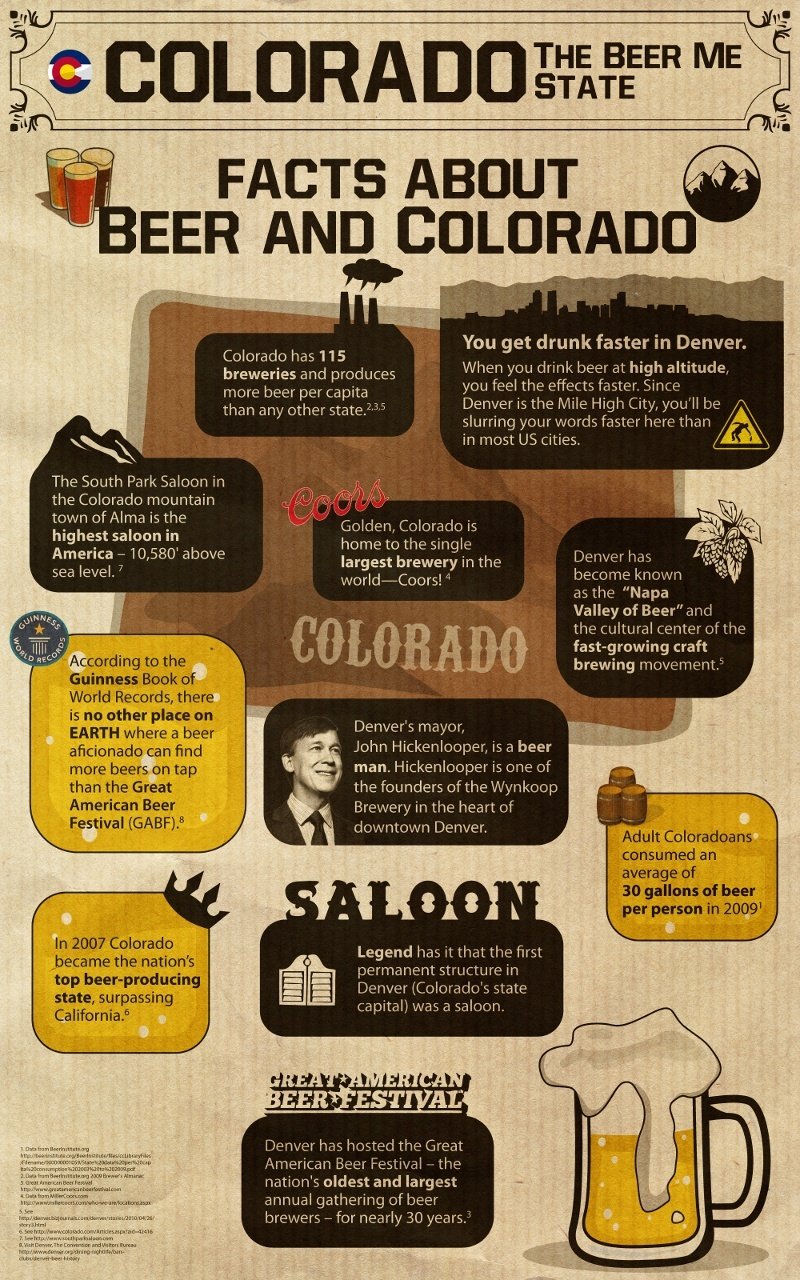
Colorado Beer Facts

Denver Colorado Beer Facts